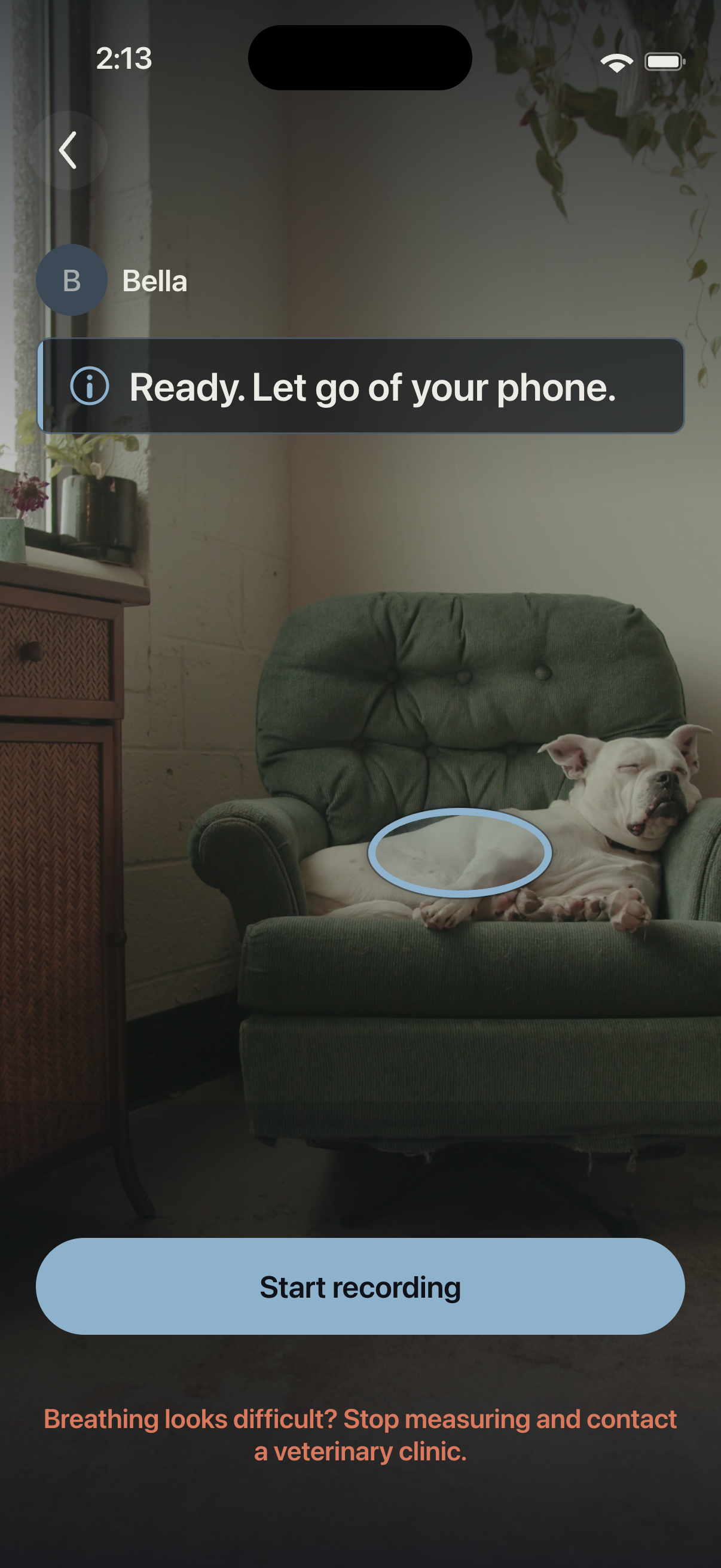
1. Prop. Lean your phone against a mug or a book. Frame their chest or flank. Tap once where the chest or flank moves, and let go.
FOR DOGS WITH MVD & CATS WITH HCM
Sixty quiet seconds.
Prop your phone next to your sleeping dog, tap once where the chest or flank moves, and let go.
In sixty seconds, RestCount measures their resting breathing rate — no collar, no touching, no waking them — and keeps the record your vet actually wants to see. When a recording isn’t reliable enough, RestCount shows no number.
In development — assisted beta. Home-use accuracy is not yet established. Any $10 reservation deposit is held fully segregated and refunded automatically if we can’t deliver. See the validation log →
If your dog has MVD, or your cat has HCM, you’ve heard the instruction: “Count their sleeping breaths, a few times a week. Call me if the number climbs.”
So you kneel by the bed with a stopwatch. You lean in — and they wake up, and the count is ruined. You get 19. Or was it 21? You write “20-ish?” on a sticky note and hope you catch the night it matters.
You’re not bad at this. The method is.
1. Prop. Lean your phone against a mug or a book. Frame their chest or flank. Tap once where the chest or flank moves, and let go.
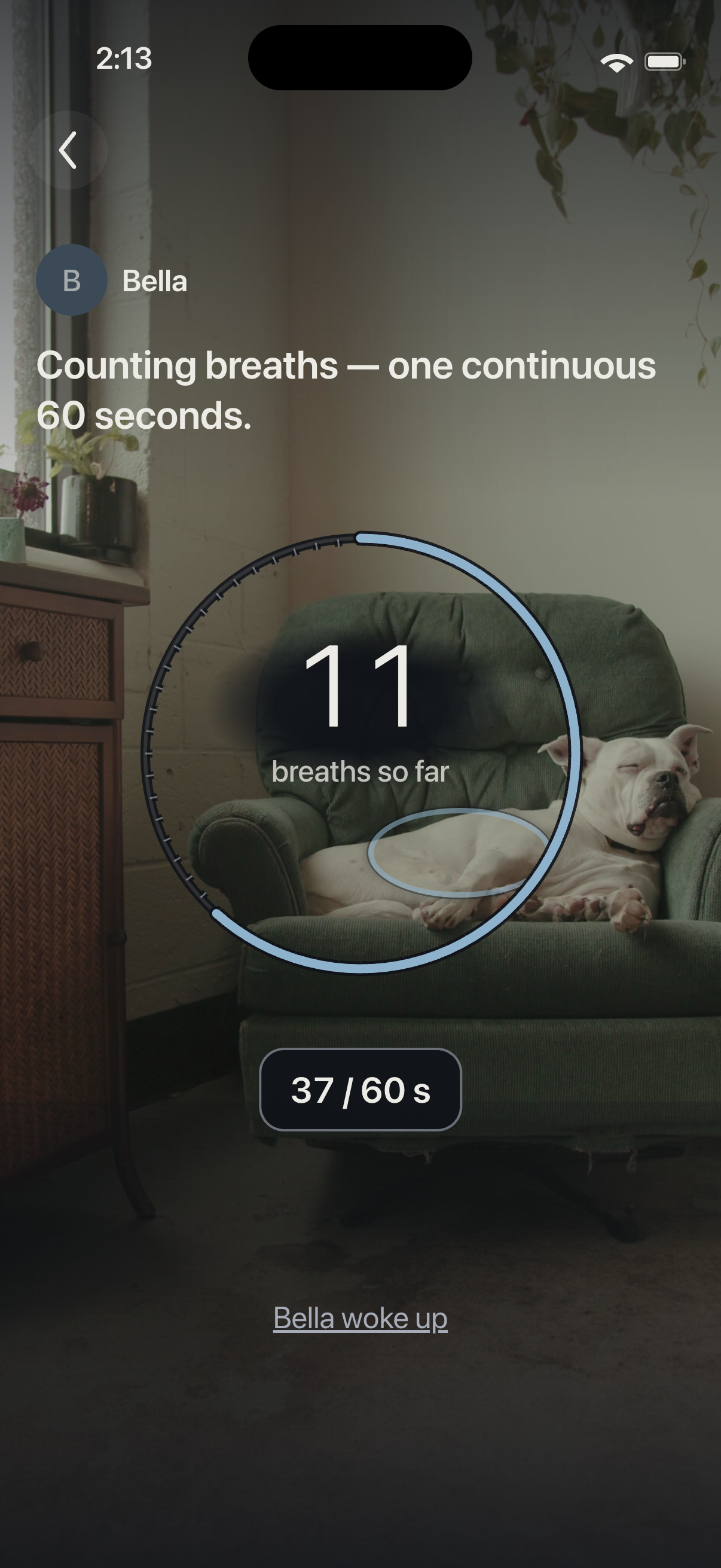
2. Wait. RestCount records one continuous 60-second window. If they stir, the window restarts — and if tonight just won’t measure, it tells you so instead of guessing.
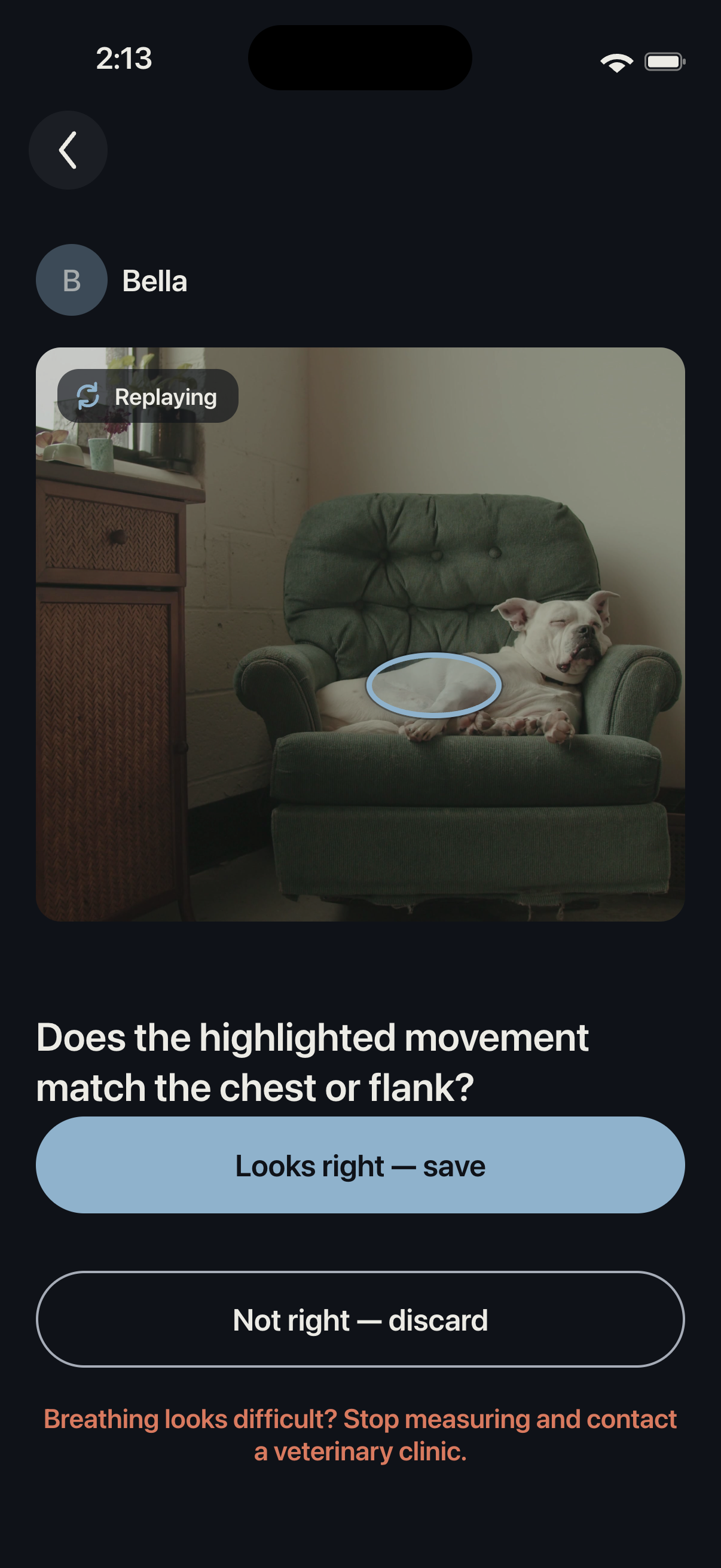
3. Check & keep. You review the highlighted movement, confirm it matches the chest or flank, and the number is saved on this device.
Assisted-beta walkthrough. It uses licensed stock footage of a real dog processed with our current proof-of-concept. It does not analyze uploads or promise a result for your dog.
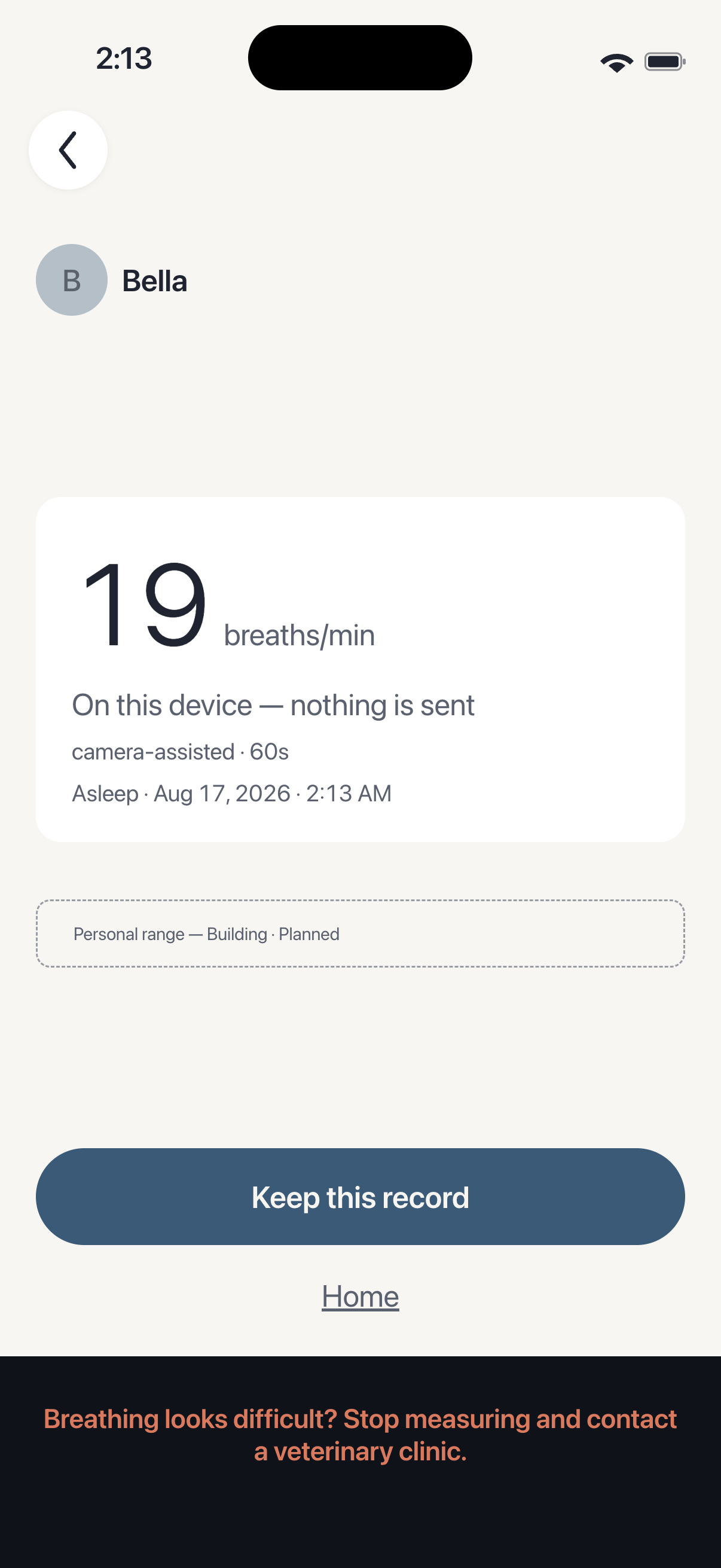
At the appointment, a number is only worth as much as the proof of where it came from.
Assisted-beta walkthrough. It uses licensed stock footage of a real dog processed with our current proof-of-concept. It does not analyze uploads or promise a result for your dog.
Study limits: 27 dogs in the published study; manual ROI and per-video tuning; our home-use accuracy is not yet established.
Our method builds on peer-reviewed research (Scientific Reports, 2025): smartphone video of sleeping dogs matched manual counts to within about one breath per minute under study conditions.
RestCount is designed to work from across the room. Prop your phone up, step back, and let them sleep — nothing held near their face, nothing worn, nothing to charge. No special depth sensor required; a recent iPhone is enough.
A naïve signal-to-noise score is not a valid acceptance test: a blank wall scored SNR 198.1 — 4.9× the sleeping dog (40.4). That is exactly why RestCount verifies the movement and refuses, instead of trusting the highest raw score.
Higher is not better. Three inert control regions outscore the dog, so a raw-SNR threshold would “accept” a wall. The accepted result comes from verification, not from the largest number.
| Region | Type | SNR |
|---|---|---|
| Dog | Accepted | 40.4 |
| Wall, upper-right | Control | 198.1 |
| Floor, lower-left | Control | 21.2 |
| Chair seat underside | Control | 11.6 |
| Wall, upper-left | Control | 8.5 |
We’re now validating it in real homes — dark rooms, black coats, curled-up cats included — and we publish what works and what doesn’t. Read the validation log →
A number you can’t trust costs more than no number at all — you’d act on it.
REFUSED — no number shown
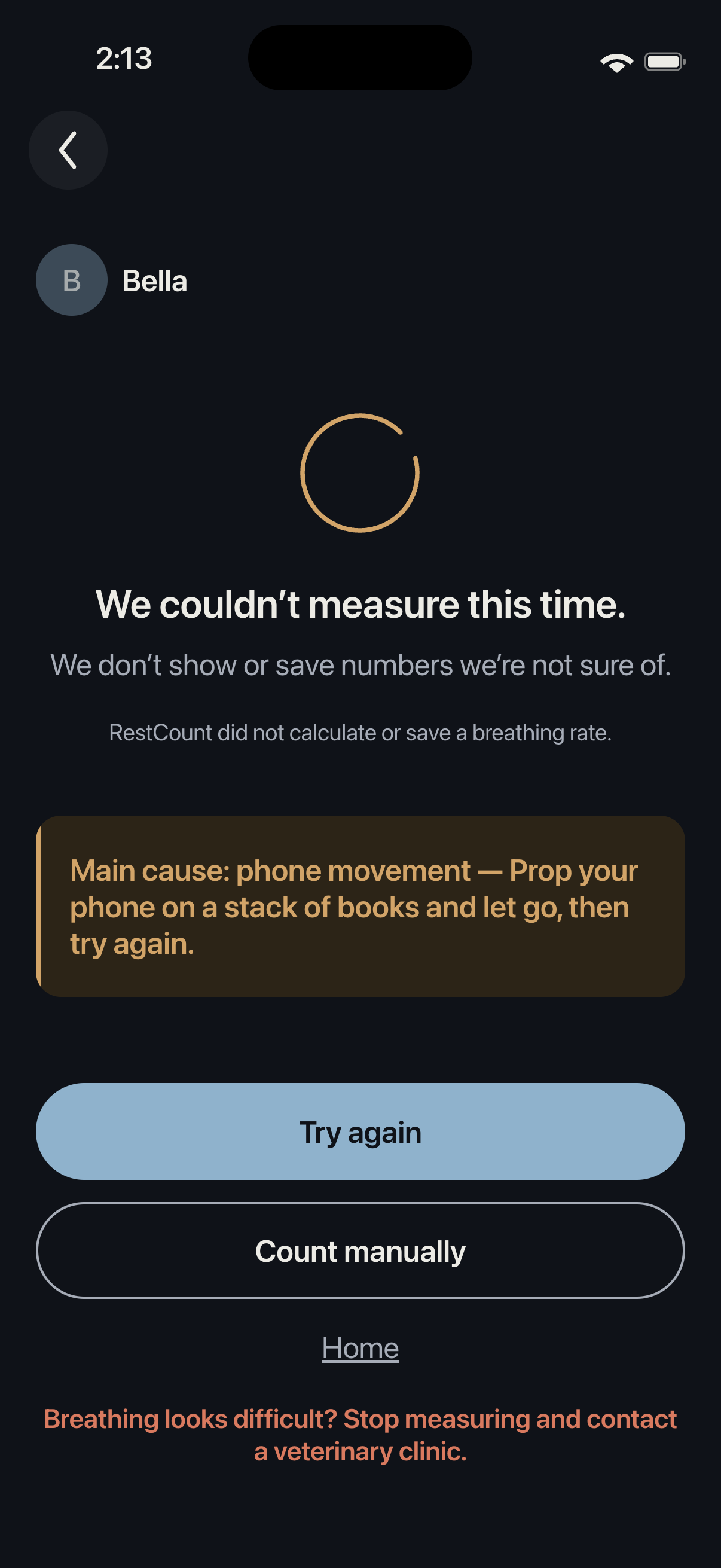
We don’t show or save numbers we’re not sure of.
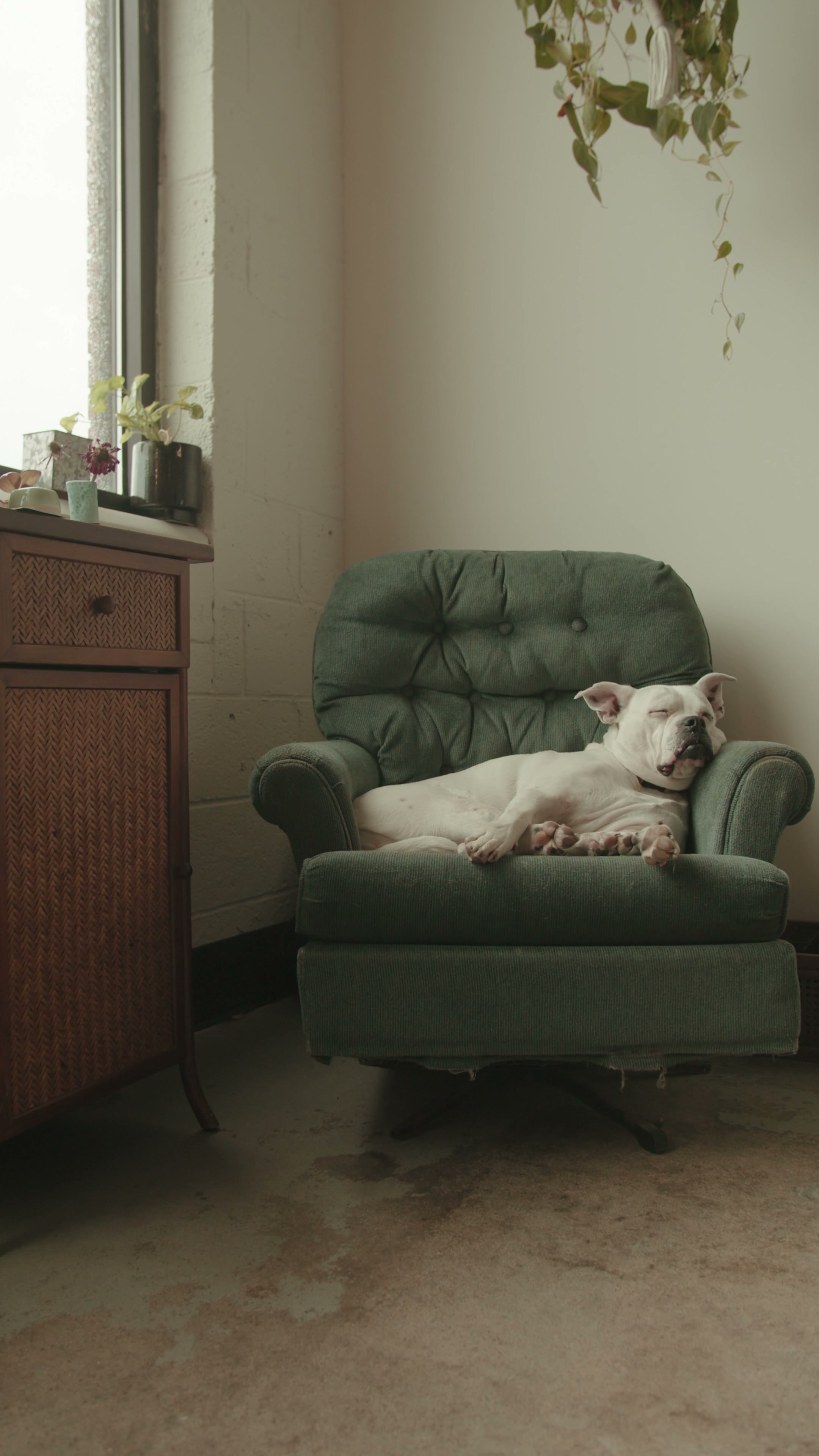
This recording moved too much to trust, so no rate was produced.
RestCount did not calculate or save a breathing rate.
The validation log lists every condition in which we refuse to show a number — dark rooms, black coats, curled-up pets — with the raw clips. Read the validation log →
Nothing is saved until you check it. RestCount replays the highlighted movement and asks one question: does it match the chest or flank? You confirm — it saves. You disagree — it’s discarded, entirely. Saved values can’t be edited; a number you could edit wouldn’t be a record your vet can trust.
Feline measurement is not part of this release and is not yet validated. If your cat has HCM and your vet asked for home breathing counts, join the waitlist as a cat household — we use it to measure demand, and we’ll tell you the truth about what works.
PLANNED RestCount keeps records. It does not diagnose, treat, or predict — that’s your vet’s job. A shareable summary is planned: A record you send — not continuous monitoring.
A free, one-time, human-verified count of a 60-second video — for households whose vet has already asked for resting/sleeping breath counts. No veterinarian reviews the video. The result is one sentence: “We counted visible chest-rise cycles during the submitted 60-second video.”
25 of 25 remaining
Request a free countThe reservation that follows is for households whose veterinarian has already asked for resting or sleeping breath counts. Six questions confirm whether that’s your situation — the offer stays hidden until you answer.
You are keeping a record your vet can read — and one that stays on your phone.
RestCount is in development and not yet released. Home-use accuracy is not yet established. What you see above is an assisted-beta walkthrough and concept UI. The reservation below is a $10 fully refundable deposit, held fully segregated and never used for development costs — nothing else is charged today.
If we can’t deliver, miss the deadline, or can’t grant the Pass, you are refunded in full — automatically, no request needed.
Deposits and Pass payments are kept fully segregated and are not used for development costs.
$10 fully refundable deposit — credited in full toward the $19 Founding First-Year Pass.
The Pass covers one year of use, starting on the day the finished app is officially released on the App Store.
Standard price: $49.99/year. No auto-renewal.
Delivery target: 2026-12-15
Cancel anytime before delivery — one click, full refund. Delivery target: 2026-12-15.
Not ready to reserve? Leave your email for the validation-log updates.
Honestly: those are the hard cases for any camera-based method, and they’re the center of our validation right now. We’d rather tell you “tonight won’t measure” than hand you a wrong number — and founding members get our validation results first, including the conditions where we fail. What we can promise today: you set the phone down and walk away. No aiming at their chest from a foot away — because the moment you lean in, the measurement wakes the patient.
No. RestCount is an informational record-keeping tool. It doesn’t diagnose, treat, cure, or prevent anything, and it never replaces your veterinarian.
In-app measurement runs on your phone; that footage never leaves it. We store numbers, not video. The free count service and optional research uploads are separate, clearly labeled channels with their own consent step — nothing is uploaded silently.
Then some nights won’t measure, and we’ll say so. A missing number is better than a wrong one.
When it clears our accuracy bar in real homes — not before. If we don’t clear the bar, we don’t ship — and your deposit is refunded in full, automatically. Beta testing, when it opens, is free and open regardless of purchase.
Yes — anytime before delivery, one click, full refund of your $10 deposit. If we can’t deliver, you don’t even need to ask: the refund is automatic.